End-to-end communications
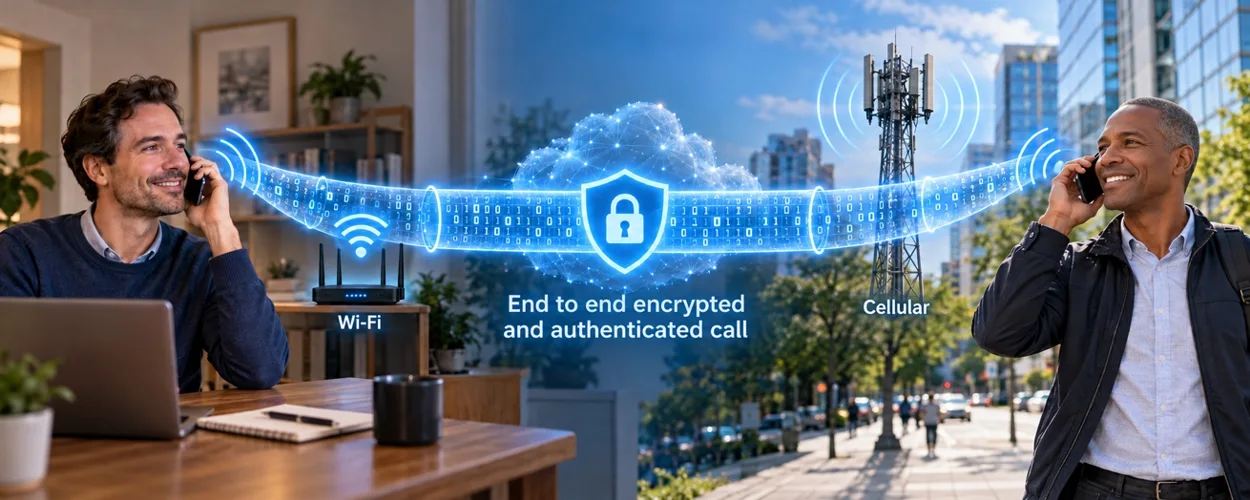
Authenticate endpoints and protect traffic across existing links, including when traffic crosses networks managed by different providers.
Qubit Moving and Storage, LLC (QMS)
Entropic Security™ Tokens
QMS Entropic Security™ Tokens are implemented in hardware and used for authenticating people and devices, protecting communications, and securing stored information. Matching tokens are provisioned optically before deployment.

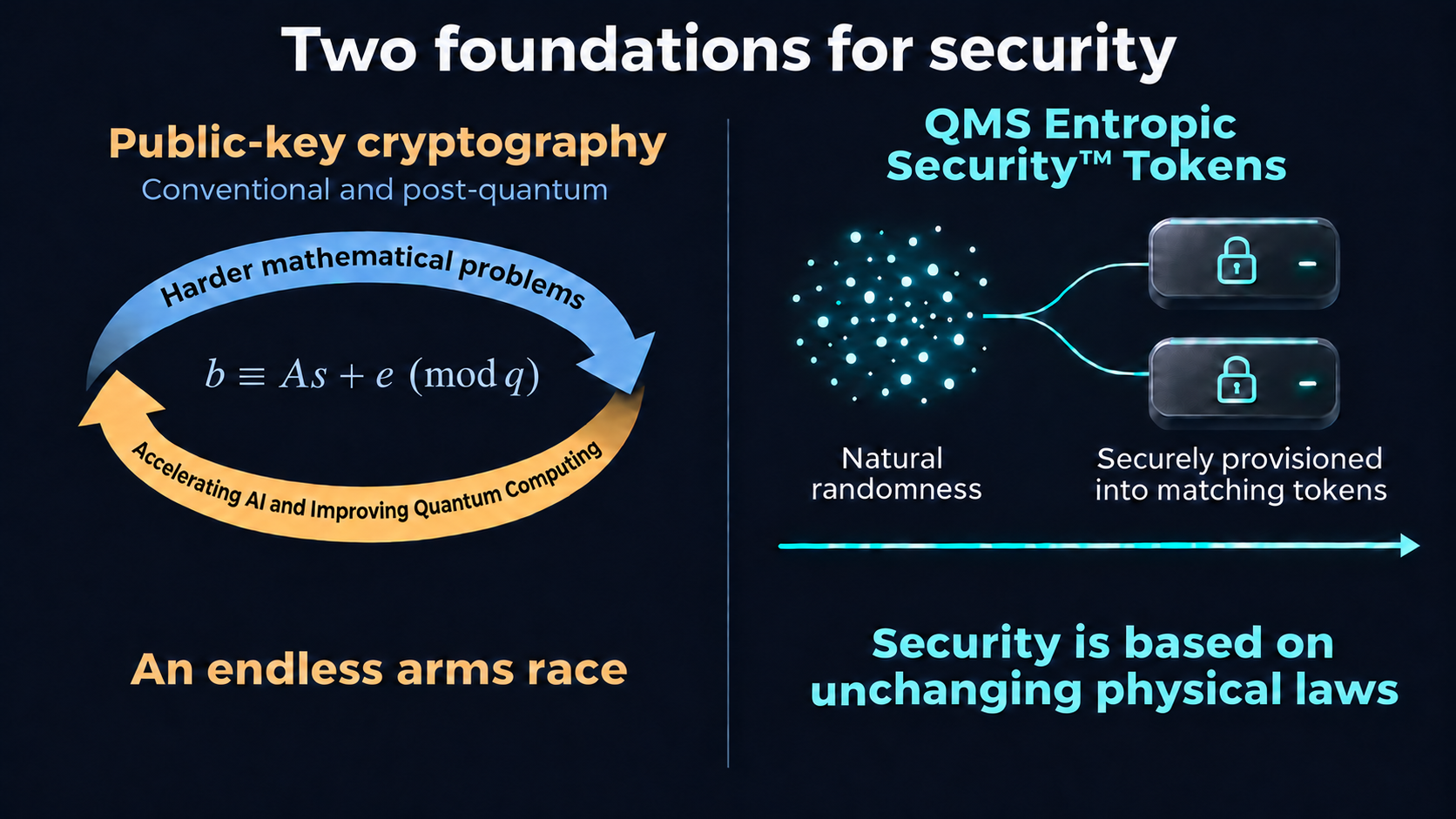
Public-key cryptography relies on mathematical problems staying practically unsolvable. Advances in mathematics, AI, and quantum computing will change which algorithms can be trusted in an instant. Post-quantum public-key infrastructure is designed to resist currently known quantum attacks, but its long-term security still depends on mathematical assumptions. Massive numbers of AI agents can act like a team of mathematicians and cryptographers searching for a weakness in what was assumed to be an "unsolvable" math problem.
QMS Entropic Security™ Tokens take a different approach. Matching tokens are securely provisioned with randomness drawn from physical processes. That shared key material supports confidentiality, message integrity, and authentication. Advances in computing, AI, quantum computers or mathematics do not make true randomness more predictable or QMS Entropic Security™ Tokens less secure.
Urgent cryptographic migrations can disrupt the systems people rely on. It's in the news every day. By reducing dependence on public-key algorithms for these functions, QMS is designed to greatly reduce the need for emergency migrations and help keep services available.
We know, you need all 3.
Hardware-backed trust for systems that need to authenticate people and devices, protect sensitive communications, and secure information in storage.
QMS employs optically provisioned, high-entropy key material to establish trust between matching tokens and provision keys. Public-key systems employ the computational difficulty of mathematical problems which are vulnerable to advances in quantum computing.
Tailor QMS to your use case, from lightweight, low-cost deployments with strong security to configurations built for the most demanding security requirements.
AI agents can coordinate to find weaknesses in specific instances of complexity-based security schemes, compromising those users.
AI systems are finding new solutions to problems that have stumped mathematicians for years. QMS security is based on entropy of natural systems, not computational complexity.
Data is protected by entropy, not by the complexity of an algorithm which may be defeated in the future by AI, mathematical advances or quantum computing.
The hardware is designed to keep loaded keys and identification nonces unknown to both users and administrators, protecting against human error and adversarial social engineering attacks.
QMS is designed to protect loaded keys and nonces during transport, storage, and use, and activate them only as needed. After loading and before use the key material in a token is inert. The key does not exist until needed.
In-person optical provisioning establishes trust between matching tokens. Tokens use pre-loaded identification material to authenticate.
Provisioned tokens are designed to protect end-to-end exchanges over existing civilian and government communications links and networks.
The compact and resource-light design targets low-cost integration into cards, USB tokens, and embedded devices.
The optical loading process provides matching, high-entropy random key material.
Pairs or groups of users holding matching tokens can operate independently without relying on a central certificate authority for their authentication. There is no single point of vulnerability.
See how QMS, quantum key distribution, symmetric keys, and traditional and post-quantum public-key systems compare on authentication, deployment, and more.
Technology
A quantum optical loading system provisions matching tokens with cryptographic keys and identification nonces. The loaded cryptographic keys and identification nonces are inert until activated, referred to as latent key material. Deployed tokens use the latent key material to authenticate users and encrypt communications over existing communications links.
Establish the identity of a person or device at provisioning. An issuer can verify a cardholder in person.
Connect two or more tokens to a loading system over fiber or free-space optics. The system provisions the group with matching latent key material in protected hardware.
Put tokens into service in credentials, dongles, or embedded devices. As needed, tokens activate latent key material to be used for authentication or encryption.
QMS tokens work over any data link or network, whether private or public, including the Internet.
Applications
QMS tokens can support a wide spectrum of security levels and cost points, depending on the application. Examples of deployments with pre-enrolled participants or devices.
Authenticate endpoints and protect traffic across existing links, including when traffic crosses networks managed by different providers.

Embed tokens in badges or other credentials. Use one-time values for access checks and deactivate a missing credential at the access system.

Use a USB token or embedded hardware to authenticate a remote endpoint and protect its connection over the internet.
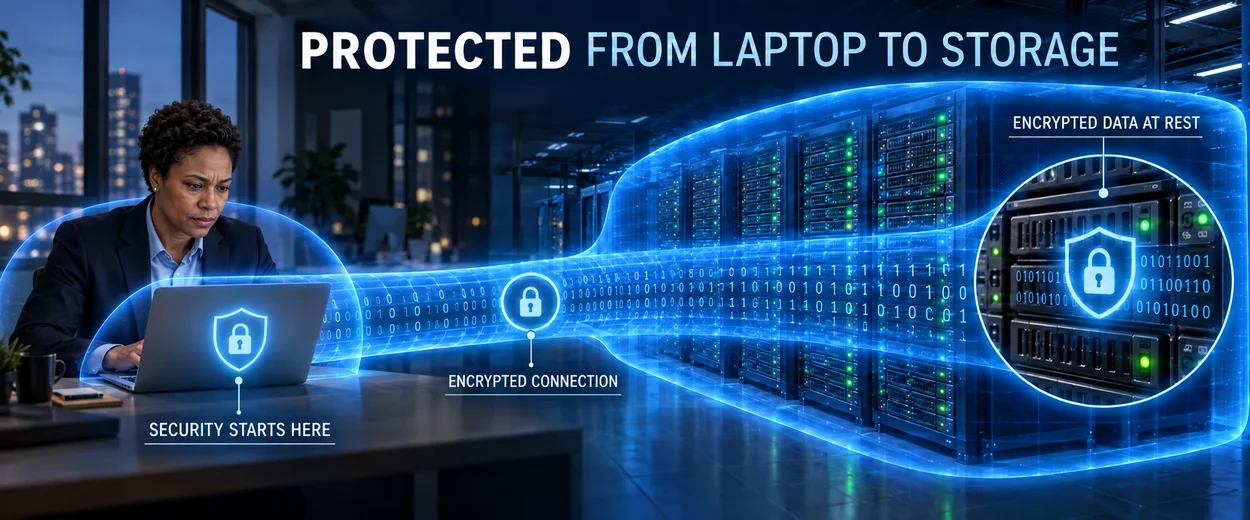
Encrypt data at its origin and keep it protected through storage. The deployment determines how keys are provisioned, used, and replenished.
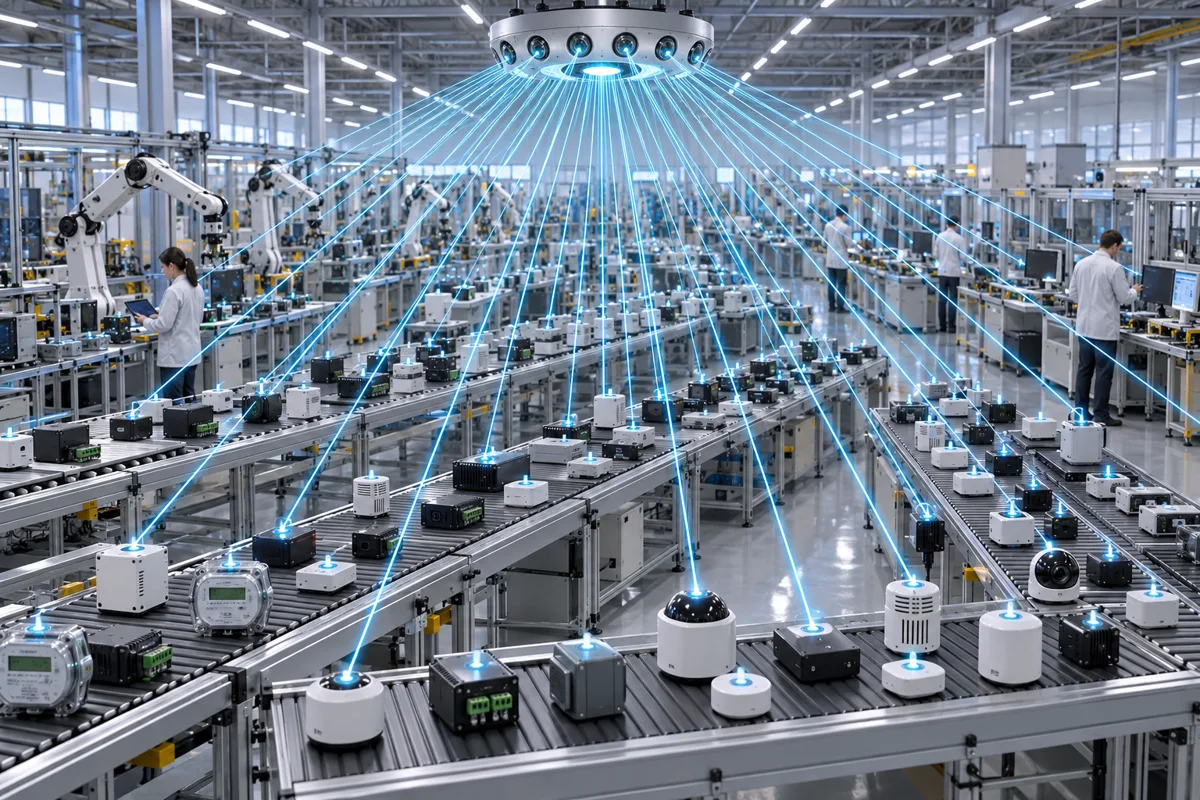
Provision groups of devices during manufacturing or enrollment to establish device identity and secure machine-to-machine links.
Security model
QMS accommodates pre-enrolled groups. Each group can operate as an independent security domain. Matching tokens are designed to authenticate within that domain without a central certificate authority.
The design keeps loaded keys and nonces unknown. A key does not exist until two or more users agree.
A suitable deployment can use one-time-pad encryption. This confidentiality guarantee requires uniformly random secret pad material at least as long as the message, used only once.
Optical technology is used only during provisioning. After loading, tokens can operate over existing communications links, subject to integration with the endpoints and applications.
Intellectual property
QMS lists patent work in quantum information, shared randomness, and verification.
Contact
We are actively seeking partnerships to accelerate our product roadmap. Contact us if you want to: